
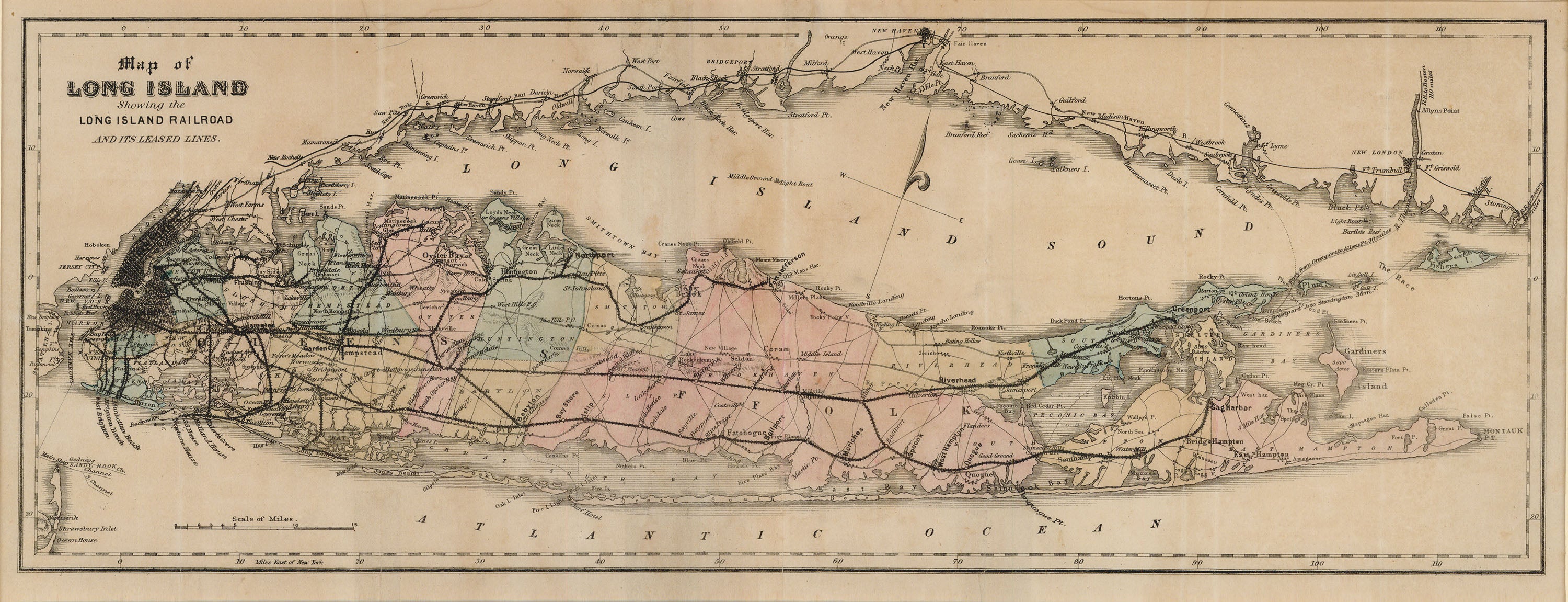
- Title: Map of Long Island
- Author: G.W. and C.B. Colton
- Date: 1882
- Medium: Hand-colored lithograph
- Condition: Very Good - age toning, foxing, wear along fold lines
- Inches: 21.75 x 8.25 [Image]
- Centimeters: 55.2 x 20.9 [Image]
- Product ID: 233154
The map illustrates Long Island stretching from the densely detailed, urbanized west near New York City to the rural eastern tip at Montauk. Black lines trace the extensive network of the Long Island Railroad and its affiliated routes, connecting communities such as Jamaica, Hempstead, Hicksville, Patchogue, Riverhead, and Sag Harbor. The island is divided into pastel-shaded sections that mark different counties and townships, with towns, villages, and notable geographic features like bays, points, and offshore islands carefully labeled throughout. The northern boundary of the map shows Connecticut across Long Island Sound, while the southern coast faces the Atlantic Ocean, including details like Fire Island. Steamboat and ferry routes are depicted as dashed lines, indicating water connections to places such as New London and Manhattan. The overall style and typography reflect a late 19th-century cartographic aesthetic, serving both as a practical travel guide and a historical record of Long Island’s railroad expansion during that era.
Background on Creator
Joseph Hutchins Colton (1800-1893) moved to New York City from his birthplace of Longmeadow, Massachusetts to start the J.H. Colton Company in 1831. Though he did not come from a cartographic or engraving background, Colton licensed copyrights from other cartographers such as David H. Burr and Samuel Stiles, producing quality reprints with additional engraving and border detail. After ten years of operating with this business model, Colton branched out to produce original maps, and by the 1850s had grown his company into a booming cartographic firm. Though the Colton Company published a variety of cartographic materials such as guidebooks and atlases, it is perhaps best known for its railroad maps. Distinguished by their elaborate decorative borders, Colton maps were printed using engraved steel plates which, though more costly than wax engravings, produced higher-quality images. These maps were then hand-colored by watercolor artists, resulting in slight irregularities which reflect the documents’ unique history and individualized production.
Notable moments in Colton’s career include winning a high-profile lawsuit against the government of Bolivia, by whom he had been hired to produce some 2,500 maps of the region in 1857. When he did not receive pay upon completing his contract, mostly due to Bolivian civil unrest, Colton took legal action and eventually received $100,000 in compensation.
Colton’s sons George Woolworth Colton (1827-1901) and Charles B. Colton (1832-1916) joined the company in the early 1850s; when the two eventually took over from their father, they renamed the firm to G.W. & C.B. Colton. A few years later in 1898, the brothers went into business with August R. Ohman, renaming the firm again to Colton, Ohman, & Co. This relationship lasted until 1901 when the Coltons left the company and Ohman took over in full, subsequently dropping the Colton name.